

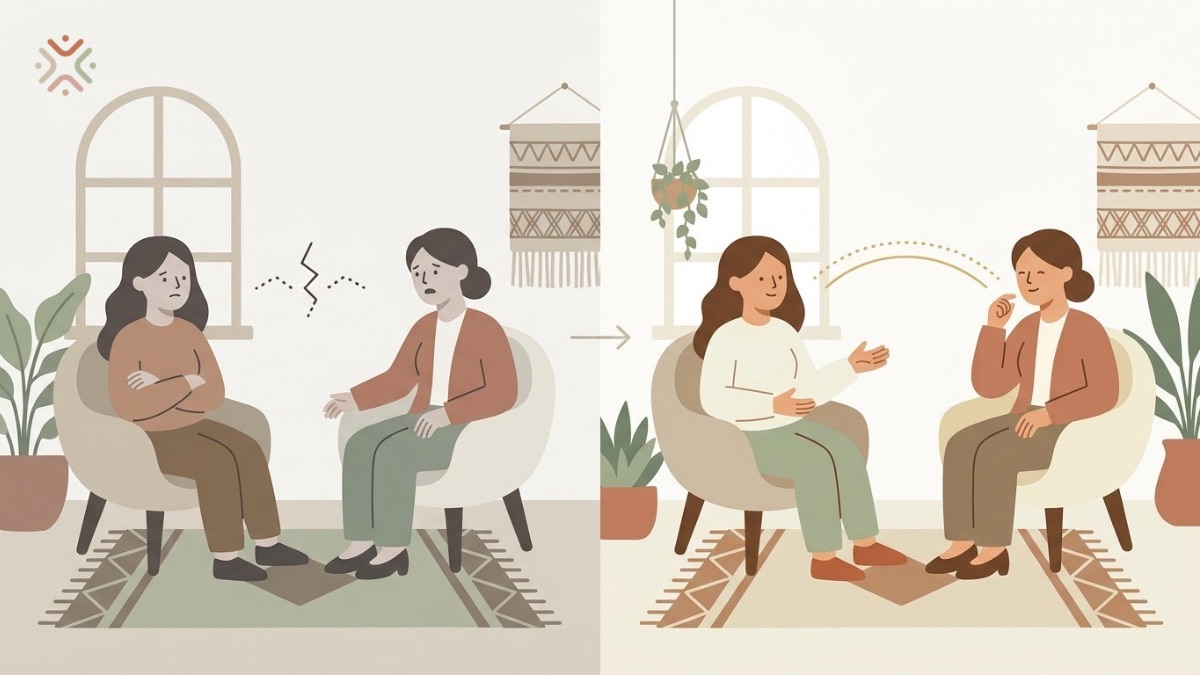



Not clicking with your therapist?" What 30,000+ patients reveal about finding the right fit
Myth: you need the perfect therapist match from Day 1. Otherwise you'll feel "not understood".
Reality: good enough starts; therapy builds the real connection.
"I don’t feel understood." "We’re just not clicking." "Stuck in an anxiety loop, I need someone who gets my overwhelm."
The belief that you need instant chemistry, a perfect "match made in heaven" from Session 1, is everywhere online. But what if that’s putting unnecessary pressure on you?
Decades of clinical research, spanning hundreds of studies and tens of thousands of patients, have investigated a deceptively simple question: does a therapist-client pair need to "click" from the very beginning, a kind of match made in heaven, or is the quality of the therapeutic relationship something that develops and deepens through the therapeutic process itself?
What the evidence definitely suggests is that the answer is not one or the other. It is both, in different proportions, and with important caveats that complicate any simple narrative. Here's what the science actually says.
Does similarity make a better match?
The intuition seems obvious: if your therapist shares your background, your values, your personality, shouldn't that make therapy work better?
In 1998, researchers at Columbia University studied 50 therapist-client pairs engaged in twice-weekly psychodynamic psychotherapy for about a year (Dolinsky et al., Journal of Psychotherapy Practice and Research). Two-thirds of pairs agreed on whether the match was positive or negative. More than half, on both sides, called it positive. Patients who felt well-matched also tended to feel therapy was progressing and that they and their therapist shared a sense of direction.
But the critical finding was what didn't predict match quality: perceived similarity. Shared sense of humor, political values, cognitive style, personality, none of it correlated with whether the match felt good. In fact, when asked whether they were similar or different, patients and therapists didn't even agree with each other. They had different perceptions of their own likeness.
Perhaps most striking: 43% of patients rated the match as negative, yet every one of them continued therapy. A poor initial impression did not end the work.
The researchers concluded, in their own words, that "the concept of match does not add to our understanding of the therapeutic relationship or process, at least in the midphase of long-term treatment." They ended their paper with an open question: is the match a heaven-sent gift, or a partnership that therapy itself creates?
Worth noting: This was a small study of mostly Caucasian university students with trainee therapists. Early dropouts, people who left because the match was bad, were not captured. The findings are suggestive, not definitive.
The therapeutic alliance: what actually predicts whether therapy works
If personality similarity doesn't reliably predict outcomes, what does?
The most robust answer in the entire psychotherapy literature is the therapeutic alliance : the sense of working together toward shared goals, agreeing on what therapy should look like, and feeling an emotional bond of trust and safety. This is not a personality trait of the therapist or the client. It is something that emerges between them.
The largest meta-analysis ever conducted on this topic (Flückiger et al., 2018, Psychotherapy) synthesised 295 independent studies covering more than 30,000 patients across nearly four decades of research. The finding: a consistently moderate, positive relationship between alliance strength and therapy outcomes, and the result was essentially identical for online therapy as for face-to-face. This is reassuring for anyone seeking help online.
Crucially, the alliance built over time was a stronger predictor of outcomes than the alliance measured early in therapy. The relationship that matters most is not the one that existed at the start; it's the one that has been constructed through weeks and months of shared work.
This finding has been remarkably stable. Four separate meta-analyses spanning from 1991 to 2018 have found virtually the same result, despite the number of studies tripling. It holds across therapy types: CBT, psychodynamic, humanistic, and across research designs.
The honest caveat: Correlation is not causation. It's possible that clients who are already improving rate the alliance more highly, rather than the alliance itself causing improvement. Researchers have tried to control for this by accounting for early symptom change, and the relationship holds, but definitive proof of causation remains elusive.
Rupture and repair: the alliance is made, not found
If the alliance predicts outcomes, the next question is whether it's something you either have or you don't, or something that gets actively built. The rupture-repair literature provides a compelling answer: it's built. And sometimes, it's built through difficulty.
Ruptures are moments of disconnection, tension, or misunderstanding between therapist and client. They are normal. Every therapeutic relationship has them. What matters is what happens next.
A 2018 meta-analysis (Eubanks, Muran & Safran, Psychotherapy) examined 11 studies with over 1,300 patients and found a clear, moderate association between successfully resolved ruptures and positive therapy outcomes. But here's the finding that challenges our assumptions: clients who experienced a rupture that was then repaired showed better outcomes than clients whose therapy had no ruptures at all.
This suggests that working through relational difficulty, naming the tension, exploring it together, rebuilding trust, may itself be a therapeutic process. It provides what clinicians call a "corrective emotional experience": the lived proof that a relationship can survive conflict. For many clients, this directly addresses the interpersonal patterns that brought them to therapy in the first place.
Safran and Muran's earlier research (1996) mapped what successful repair looks like: the therapist notices the disconnection, invites the client to explore what they're feeling, helps them move past avoidance, and creates space for honest, direct expression. In sessions where repair didn't happen, the process stalled early: the deeper emotional work never began.
Honest caveat: These studies observed naturally occurring ruptures. No researcher deliberately created conflict to test repair (which would be unethical). It's possible that clients who were already on a good trajectory were better at collaborating in repair. Training therapists in rupture repair has shown small, inconsistent effects in the few studies that have tested it, promising, but not proven.
Does demographic matching matter?
Many clients seek a therapist who shares their racial, ethnic, or gender identity. The research validates this preference, while revealing a surprising gap between what clients want and what measurably changes outcomes.
'Racial matching'
A comprehensive meta-analysis by Cabral and Smith (2011, Journal of Counseling Psychology) examined decades of research across 186 studies and found three distinct patterns. Clients showed a moderately strong preference for therapists of their own ethnicity. They also tended to perceive 'same-race' therapists somewhat more positively. But when it came to actual treatment outcomes, whether symptoms improved, the effect of racial or ethnic matching was close to zero.
All three findings showed substantial variability across studies, meaning the effects differ depending on the specific populations and settings involved. Studies involving African American participants showed the strongest effects across all three measures: preferences, perceptions, and outcomes.
Gender
For gender, the pattern is similarly layered. A large study of over 17,000 clients found that female clients improved more than male clients overall, but the gender of the therapist, or the match between client and therapist gender, didn't independently predict outcomes. Gender-matched pairs did tend to attend more sessions. A separate German study of over 1,200 patients found that female therapist–female client pairs did better in psychodynamic therapy, but this didn't hold in CBT.
Recent research adds an important layer: a 2025 study of over 2,500 university counselling clients found that women of colour with high initial distress and prior therapy experience were overrepresented among clients with persistently low early alliance scores. Standard statistical methods missed this pattern: it only emerged when researchers looked at intersecting identities together rather than in isolation.
What this means practically: Preferences matter. They affect whether clients feel safe enough to start, and whether they stay long enough to experience the benefits of therapy. But demographic similarity alone does not reliably predict whether someone will get better. The preference is real and worth honouring; it's just not the whole picture.
Personality matching: some helps, some hurts, most doesn't affect the outcome
A 2024 study in Psychotherapy Research examined 77 therapist-client pairs in short-term therapy and tested whether matching on Big Five personality traits and attachment styles improved outcomes. The results were genuinely mixed.
Matching on conscientiousness (Conscientiousness is a personality trait describing how organised, responsible, and hardworking someone tends to be. People high in conscientiousness usually plan ahead, keep their commitments, follow through on tasks, and think about the consequences of their actions.) both high, or both low, was associated with symptom improvement. Matching on neuroticism at the extremes also helped, which the authors speculate may reflect a kind of emotional resonance, though this is untested. But matching on attachment anxiety, when both therapist and client were highly anxious about relationships, or both very low, was associated with worse outcomes. The authors suggest that two anxiously attached people may struggle to create a secure base, while two who are very low in attachment sensitivity may miss ruptures entirely.
For extraversion, openness to experience, and agreeableness: no detectable effect at all.
The honest picture: This was a small study with trainee therapists treating mild cases over just 16 sessions. Several findings are counter-intuitive and need replication before anyone draws clinical conclusions. The takeaway is not that personality matching is useless; it's that "similar = better" is far too simple.
Your preferences, but not the way you think
A large meta-analysis from the APA Division of Psychotherapy Task Force (led by Norcross) found that clients matched to their broad preferences: therapy type, therapist characteristics, therapeutic role, were significantly less likely to drop out and showed modestly better outcomes.
However, more recent research (Jacobsen et al., 2025, 621 clients) found that specific within-session activity preferences: preferring introspection versus practical exercises, for instance, predicted whether someone would drop out, but not whether their symptoms would improve.
This distinction matters. Preferences help people stay in therapy long enough for it to work. A client who drops out in Week 3 cannot benefit from the alliance-building that happens in Week 8. Honouring preferences is clinically important, but it is not a shortcut to recovery.
The biggest effect: therapist competence, not similarity
Research consistently suggests that some therapists produce substantially better outcomes than others. The variability between therapists accounts for a meaningful share of whether clients improve, and the most effective therapists achieve roughly three times as much client change as the least effective ones (Wampold, 2015; Baldwin & Imel, 2013).
This raises a fundamental question: is it more important to match a client to a therapist who "fits" their profile, or to a therapist who is demonstrably good at treating their specific problems?
A landmark 2021 randomised controlled trial (Constantino et al., JAMA Psychiatry, 218 patients, 48 therapists, six clinics) tested this directly. Instead of matching by demographics or personality, they matched patients to therapists based on each therapist's historical track record, years of accumulated outcome data showing which problem areas each therapist was genuinely effective with.
The results were the largest effect sizes in the entire matching literature. Patients matched to therapists with proven effectiveness in their specific problem areas improved substantially more than those assigned as usual. Even simply avoiding a therapist who was demonstrably ineffective in the client's problem area produced meaningful benefit.
An uncomfortable additional finding: therapists overestimated their own effectiveness in roughly half the areas measured. Self-reported specialisation by therapists did not match actual measured performance.
A follow-up analysis found that matching mattered most for therapists who had genuine specialisations, real strengths in some areas and weaknesses in others. For therapists who were uniformly average across the board, matching made almost no difference.
What this means: The strongest evidence for matching is not about finding someone "like you"; it's about finding someone who has actually helped people with problems like yours.
"Good fit" may be therapist skill, not destiny
One final piece of the puzzle: what feels like natural chemistry may actually be therapist skill.
In a 1998 study (Hardy, Stiles, Barkham & Startup, Journal of Consulting and Clinical Psychology), therapists delivering manualised treatments were not told anything about their clients' interpersonal styles. Yet they naturally adapted, using more emotionally-focused approaches with clients who were emotionally over-involved, and more structured cognitive approaches with those who were withdrawn. They were reading and responding to each client, in real time, without being instructed to.
What we experience as "clicking" may often be a skilled therapist adjusting to us, not a pre-existing compatibility written in the stars. The alliance, from this perspective, is a product of therapist competence in reading and responding to the particular person in front of them.
What this means for you
If you're searching for a therapist and feeling the pressure to find a perfect match, the research offers reassurance:
- Preferences matter for staying long enough to give therapy the chance to work: wanting a therapist who shares your language, cultural background, or gender identity is valid, and research shows it helps you stay engaged long enough for therapy to work.
- Early "fit" is not destiny: the alliance that predicts real change is the one built over time, not the one felt in the first 10 minutes.
- Difficulty may actually be a good sign: moments of disconnection: feeling misunderstood, frustrated, or unsure, are normal in therapy. When addressed, they may actually strengthen the relationship and deepen the work.
- Competence matters most: the strongest evidence for matching is about finding a therapist with a proven track record treating your specific concerns, not actually someone who shares your personality or background.
A "good enough" start, with a responsive therapist and an openness to the process, may take you further than waiting for perfection.
At Thera, we start with your preferences, offer a low‑pressure discovery call to test the fit, and then support you as you and your therapist build the relationship session by session:
Sources
*This article draws on peer-reviewed research including Dolinsky et al. (1998), Flückiger et al. (2018), Eubanks et al. (2018), Safran & Muran (1996), Cabral & Smith (2011), Jacobsen et al. (2025), Constantino et al. (2021), Coyne et al. (2024), Wampold (2015), Baldwin & Imel (2013), and Hardy et al. (1998). All claims reflect findings as reported in the original studies. Therapy outcomes vary by individual. This content is informational and does not replace professional clinical advice. If you are in crisis, please contact your local emergency services or crisis line.
Sharmeela P.
Founder at Thera
Category