



Therapy Guides
Culture and Identity

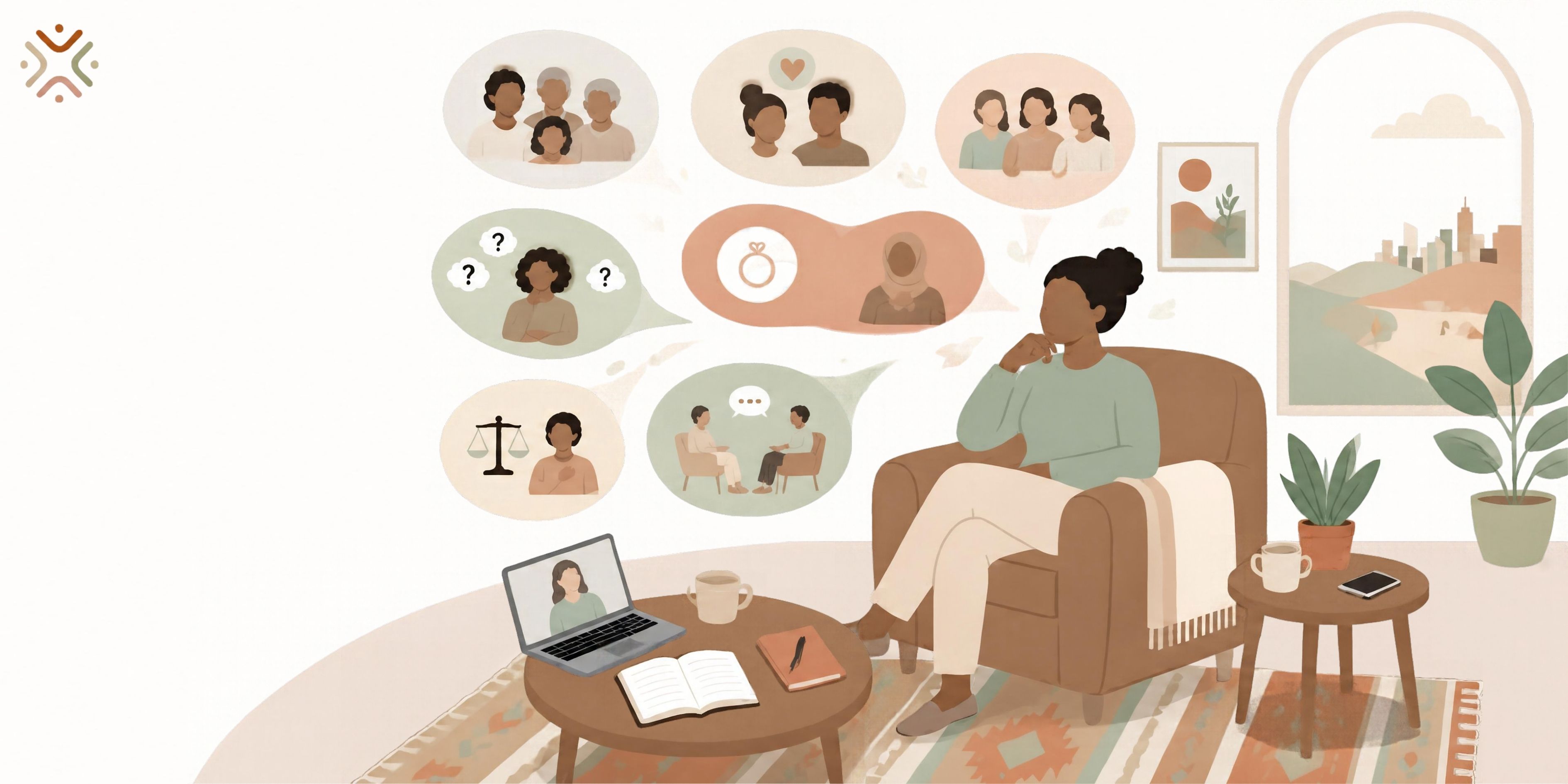
Belonging can mean different things in different settings. Some BIPOC, immigrant, diaspora and mixed-race adults feel connected to several communities; others feel misunderstood or excluded in places where they expected acceptance. Having more than one cultural identity is not itself a problem. This article focuses on the occasions when connection feels difficult or conditional.
You may feel connected to your background but also hurt by expectations within your community. You may feel accepted in professional or social spaces but still carry the weight of racism, stereotypes or code-switching. You may long for closeness with family while needing boundaries that others do not fully understand.
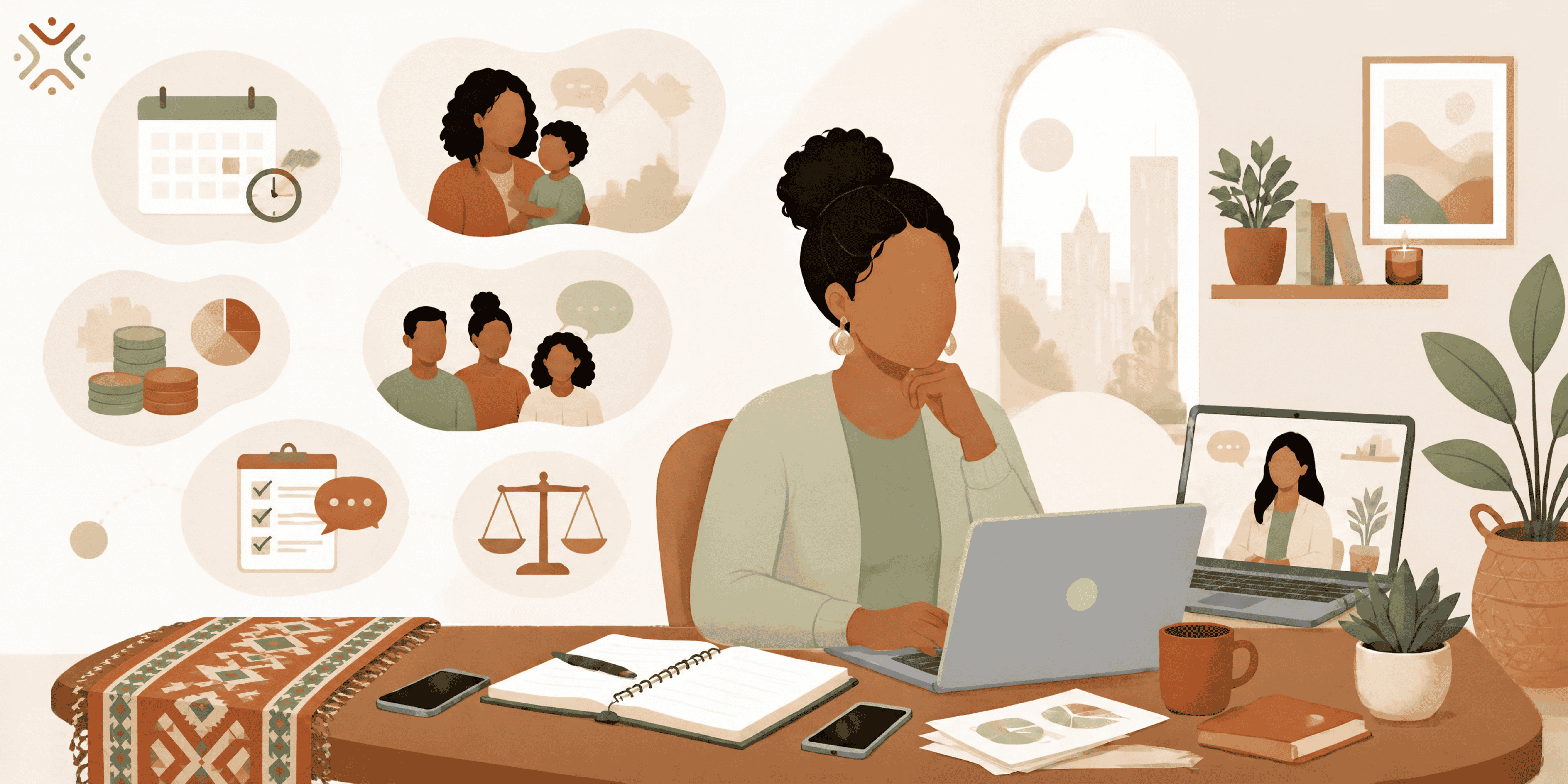
Online therapy can offer a private space to explore identity, community and emotional support without pressure to simplify who you are. It can help you understand where you feel seen, where you feel unseen and what kind of belonging feels emotionally safe.
Belonging is not only about being included. It is about feeling understood, respected and emotionally safe enough to be honest.
Experiences of belonging may be shaped by race, ethnicity, language, migration history, faith, class, disability, gender, sexuality and other parts of a person’s life. Which aspects matter, and how they interact, will differ between people and across settings.
You may feel that one part of yourself is welcomed while another part must be hidden.
This can become emotionally tiring over time.
Sometimes a space accepts part of you, but not all of you.
A workplace may value your skills but not understand the emotional cost of being the only person of color in the room. A family may love you but struggle to understand your boundaries, mental health needs or personal choices. A community may share your background but still judge parts of your identity, relationships or life path.
This partial belonging can feel confusing. You may think, “I should feel grateful to be included,” while also feeling lonely because you are not fully seen.
Online therapy can help you name that difference. Being included is not the same as feeling emotionally safe. Being surrounded by people is not the same as being understood.
Many people adjust how they speak or behave across settings. For someone navigating different languages, communities or expectations, these changes may be especially noticeable.
You may speak differently with family than with colleagues. You may adjust your humour, appearance, emotional expression or opinions depending on the space. You may feel more guarded in some rooms and more relaxed in others.
This kind of adaptation can be useful. It can help you connect, stay safe and move through different environments. But when it becomes constant, it can also become exhausting.
Different ways of speaking or relating can all be genuine parts of you. The useful question is not necessarily which version is “real,” but whether the adjustment feels freely chosen, manageable or demanded under pressure.
If this tension feels familiar, it may help to explore how living between cultures can affect identity and belonging.
Community can be healing, but it can also be complicated. Loneliness is the feeling that the connection available does not match what you need. Social isolation refers to having relatively few contacts or opportunities for interaction. They can overlap, but they are not the same: someone can feel lonely in a large group or enjoy time alone without feeling lonely. Different situations may call for different kinds of support.
You may be part of a cultural, racial, faith-based or diaspora community and still feel alone. You may feel pressure to represent the group well, avoid shame, stay silent about family problems or keep emotional struggles private.
For example, someone may feel supported by community celebrations but unable to talk about depression. Another person may feel connected to cultural traditions but judged for their relationship choices. Someone else may feel proud of their background but exhausted by expectations around success, marriage, caregiving or respectability.
Online therapy can help you hold both truths: community can be meaningful, and some community spaces can still be painful.
Feeling excluded, stereotyped or pressured to hide important aspects of your life may affect mood, relationships or confidence. Questioning your identity, however, is not itself a mental-health disorder.
When you repeatedly feel that parts of you are misunderstood, judged or invisible, you may begin to monitor yourself. You may avoid certain conversations. You may become a people-pleaser. You may feel guilty for wanting something different. You may feel pressure to prove you belong.
Over time, this can become emotionally heavy.
Code-switching is not always negative. It can be a skill, a form of cultural intelligence and a way to navigate different environments.
But if you are constantly adjusting yourself to avoid judgment, racism, conflict or rejection, it can become exhausting.
You may leave social events feeling drained. You may replay conversations to check whether you said too much. You may feel tense before family gatherings or professional meetings. You may feel like rest is only possible when no one expects anything from you.
This kind of self-protection can be understandable. It may have helped you survive certain environments. It may become tiring when you feel you have little choice, expect negative consequences for acting differently, or rarely have an opportunity to relax.
Therapy may help you consider when adapting is useful, what it costs you and where you would like more choice. The aim is not to eliminate code-switching or encourage openness in situations where discretion protects you.
Belonging can become painful when it depends on approval.
You may feel you belong only when you are successful, respectful, useful, quiet, high-achieving, agreeable, strong or emotionally available to everyone else. You may feel that making different choices means risking love, respect or connection.
This can be especially difficult in families or communities where loyalty, sacrifice and reputation are deeply valued.
A person may think:
“If I set boundaries, they will think I am selfish.”
“If I choose a different career, I will disappoint my family.”
“If I speak honestly, I will create conflict.”
“If I need therapy, people will think something is wrong with me.”
Online therapy can help separate belonging from constant approval. It can help you understand how to stay connected without abandoning yourself.
When family expectations make boundaries feel difficult, it may help to read more about finding balance without losing respect.
Some people learn that personal or family difficulties should remain private. Others grow up with encouragement to discuss them openly. These expectations vary within families and communities and may reflect privacy preferences, previous discrimination, stigma or concern about consequences.
If you have heard messages such as the following, they may affect how comfortable you feel seeking support:
“Don’t tell people our business.”
“Be strong.”
“Other people have it worse.”
“You should be grateful.”
“Do not bring shame to the family.”
“Just keep going.”
These messages may have been meant to protect you. But they can also make emotional pain feel lonely.
When shame and silence become normal, it can be hard to ask for support. Online therapy can help you speak honestly in a private setting, especially if you are worried about gossip, family reputation or being misunderstood.
If privacy is one of the reasons support feels hard to access, confidential online therapy may feel safer and more possible.
Online therapy can help you explore identity, community and belonging without forcing you into one simple label.
A therapist should ask which aspects of identity and context are relevant to you, rather than overlooking them or assuming they explain every difficulty. These parts of life may shape how you experience stress, relationships, confidence and support.
Therapy can help you understand not only what you are feeling, but also the context around those feelings.
Therapy can be one source of support, but it is not a substitute for friendships, community participation or changes in an exclusionary environment. You can also ask the therapist about their experience, language options and how they respond if you feel misunderstood in a session.
Family, work and community roles can be important parts of identity. For some people, expectations attached to those roles leave less room for other interests, needs or relationships.
These roles can be meaningful. The issue is not that these roles conceal a more “real” person, but whether you have enough choice and support within them.
Online therapy can help you ask:
Who am I beyond what I do for others?
What parts of myself feel hidden?
What do I value?
What relationships help me feel more like myself?
What spaces make me feel smaller?
What kind of community do I want?
These questions may feel unfamiliar if you are used to prioritising everyone else’s needs. But they can be important for building a more grounded sense of self.
Relationships do not need to meet every need or agree with every part of your life to be meaningful. Some may offer shared history or practical help; others may allow more personal conversation. A disagreement, awkward interaction or need for privacy does not automatically make a relationship unsafe.
More concerning patterns include repeated humiliation, discrimination, threats, coercion or punishment for expressing a preference. Therapy may help you consider those patterns and your options without automatically recommending withdrawal from a community.
This may include friends, chosen family, cultural groups, creative spaces, faith communities, support groups, professional networks or therapy.
Online therapy can help you think about what emotionally safe community means for you. It can help you recognise the difference between connection that nourishes you and connection that requires self-erasure.
Connection also depends on practical opportunities. Cost, transport, disability access, work schedules, language, discrimination and availability of suitable spaces can limit participation. Support may involve accessible activities, advocacy or practical assistance as well as reflection in therapy.
Therapy can also work alongside community support, spiritual support, family relationships and practical help when each has a clear role.
When you have spent years adapting to others, self-trust can become difficult.
You may doubt your feelings. You may ask several people for reassurance before making decisions. You may feel guilty when you want something different from what your family or community expects. You may worry that choosing yourself means betraying where you come from.
Online therapy may help you examine uncertainty, identify what matters to you and consider decisions in context. A therapist should also recognise when distrust or caution reflects real experiences of exclusion rather than a thinking pattern that needs correcting. It can support you in noticing your emotions, understanding your needs and making choices with more clarity.
The goal is not to cut off community or reject culture. The goal is to build a life where connection does not require losing yourself.
If guilt, values or inner conflict are shaping your decisions, it may help to explore how cultural values and mental health can become tangled.
Research suggests that social connection is associated with mental and physical wellbeing, while persistent loneliness and isolation may be associated with poorer outcomes. The quality and function of relationships matter alongside the number of contacts someone has. These findings do not mean that everyone needs the same amount of social contact or that time alone is unhealthy.
Professional guidance also recommends understanding identity in its social context and avoiding assumptions about people based on racial, cultural or migration categories. Support should take account of the person’s own priorities, communication needs and experiences of inclusion or exclusion.
These sources do not establish that online therapy creates belonging or that all BIPOC adults face the same barriers. Therapy may offer a place to discuss difficulties, alongside relationships, practical resources and opportunities for connection outside treatment.
Emotional support does not always need to look dramatic. Sometimes it starts with one honest conversation. Sometimes it starts with admitting that a community space feels painful. Sometimes it starts with saying, “I do not want to carry this alone anymore.”
Finding belonging may take time. It may involve grief, boundaries, trial and error, and learning to trust your own experience.
Online therapy can be one part of this process.
You might share a language with one group, an interest with another and personal experiences with a few trusted people. No single setting has to understand every aspect of your life.
If a relationship or community leaves you feeling consistently dismissed, it may be useful to consider what you want from it, what is realistic and where else you could find support. That does not have to mean rejecting your background or making an immediate decision about staying or leaving.
You might begin by discussing a specific situation: feeling out of place at work, not knowing how much to share with relatives, or wanting friendships where you spend less time explaining yourself. Those details can help a therapist understand what kind of support you are looking for.
Not everyone can find culturally sensitive support nearby. You may live in a place where your identity is misunderstood. You may be surrounded by community but unable to speak openly. You may want support from someone outside your immediate social circle.
Online sessions may widen your options beyond local services, although availability, cost, language, technology and professional authorisation still matter. They do not automatically provide more privacy: consider whether anyone can overhear you or access your device, account or appointment notifications.
You can decide what to discuss in therapy and what to share outside it. Identity exploration should not require disclosure to family, employers or community members, particularly where doing so could affect safety, housing, work or essential support.
You can explore more articles on identity, culture and emotional wellbeing on the Thera blog. You can also browse Thera’s therapist directory to look for someone whose approach feels aligned with your needs and background.
If you want to ask questions before deciding, you can book a free discovery call and explore whether online therapy feels right for you.
Belonging does not have to mean becoming easier for everyone else to understand. It can begin with becoming more honest with yourself, and finding support that makes room for the whole of who you are.
References:
Health Journalist
Nour is a health journalist, passionate about making therapy more approachable, particularly for communities living with conflict, displacement and systemic injustice. Her writing blends research with compassion, helping readers understand how mental health is affected not only by personal history, but also by the world around us.
Categories

Thera is a technology platform connecting independent mental health professionals with clients. We are not a crisis intervention service or emergency medical provider. If you or someone you know is in immediate danger or experiencing a life-threatening crisis, please contact a local emergency service or use one of these resources instead.




 Previous article