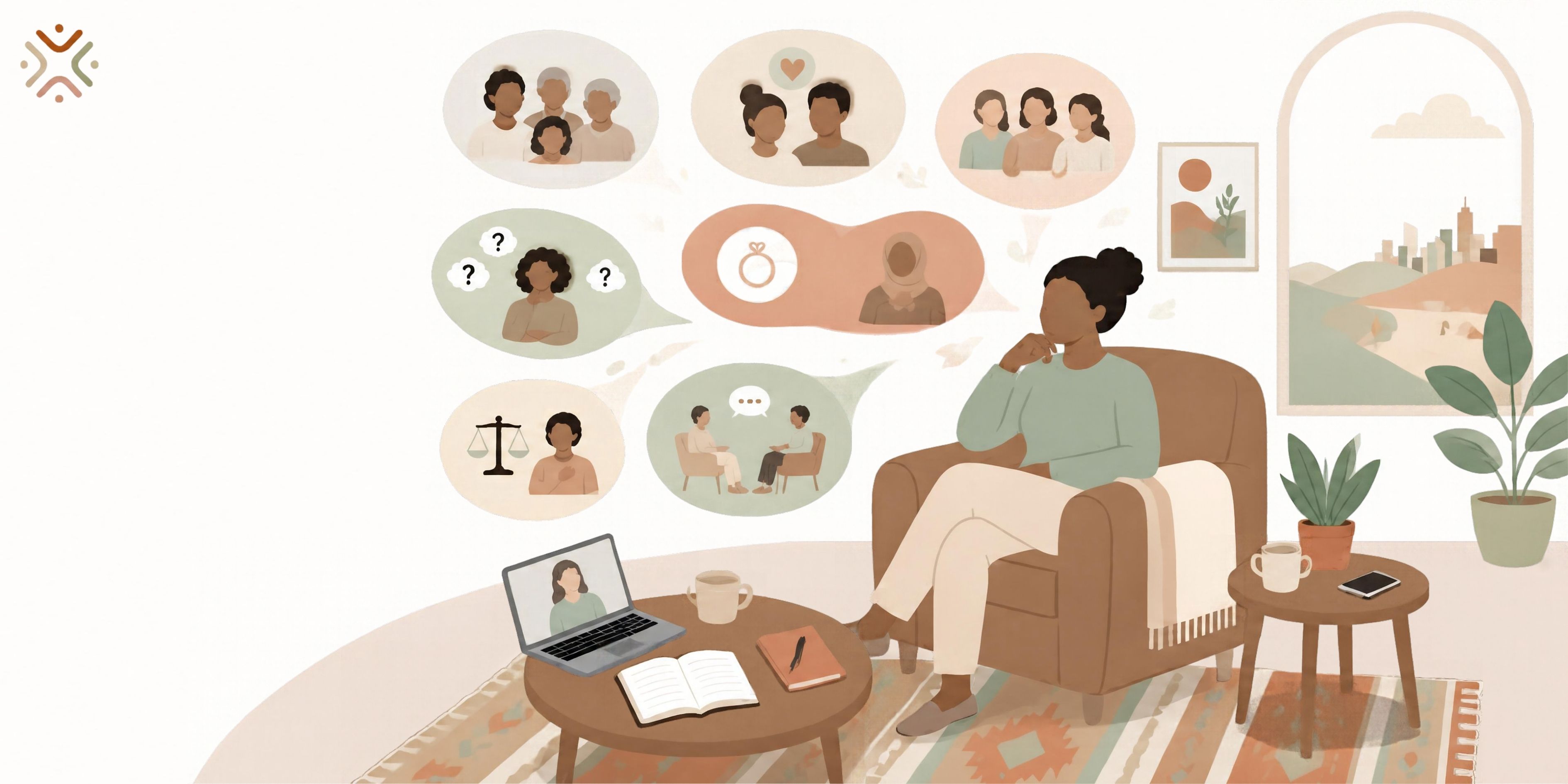
Infertility and pregnancy loss can be deeply painful, but the grief is not always visible to others. Some people also face intrusive family questions, expectations about parenthood, difficulties accessing care or uncertainty about faith and meaning. Among BIPOC, immigrant, diaspora and culturally diverse adults, experiences vary widely: family and community connections may offer comfort, create pressure or do both. Support may also be relevant to people navigating these experiences without a partner, LGBTQ+ people, non-gestational partners and people who already have children. The care someone needs should reflect their circumstances rather than assumptions about gender, marriage or family structure.
You may be grieving a pregnancy others never knew about. You may be struggling with fertility treatment while relatives ask when you will have children. You may feel isolated in a community where parenthood is closely tied to identity, marriage, family duty or adulthood.
Online therapy can offer a private, compassionate space to process grief, manage family pressure and support your relationship during a deeply personal experience. It does not replace medical advice, fertility care or specialist healthcare. It can help with the emotional weight that often comes with infertility, pregnancy loss and silent grief.
When medical care comes first
If you may be experiencing pregnancy loss, contact your maternity or pregnancy-care service rather than relying on an article to identify what is happening. Seek urgent medical help for heavy bleeding, severe pain, fever or chills, or if you feel seriously unwell. Emotional support can accompany medical care, but it cannot assess or treat a physical complication.
Why can infertility and pregnancy loss feel so isolating?
Infertility and pregnancy loss can create grief that others do not always see or understand. Some losses are private. Some are not publicly recognised. Some are surrounded by silence because talking about fertility, miscarriage, reproductive health or relationship strain feels too personal.
Isolation may become more difficult when others expect children, ask intrusive questions or assume that building a family should happen easily.
Grieving something others may not see
Pregnancy loss can involve grieving not only what happened, but also what you imagined. You may grieve a future child, a due date, a name, a role, a family picture or a version of life that had already started to form in your heart.
Infertility can also involve grief, including grief about uncertainty, interrupted plans or repeated treatment disappointments. Its meaning and intensity differ from person to person. You may grieve the hope that conception would be simple. You may grieve time, treatment cycles, uncertainty, financial strain or the feeling that your body has become a source of stress.
Because these experiences are often private, others may not know how much you are carrying. They may not understand why a family gathering, baby announcement or casual question can feel overwhelming.
Online therapy can give you space to name this grief without needing to minimise it for other people. Not everyone describes these experiences as grief though. Some people feel relief, ambivalence, numbness or changing combinations of emotions. You do not need to describe the experience as losing a child, or respond in a particular way, to deserve support.
Questions, comments and pressure from family
Questions about children can feel painful when you are dealing with infertility or pregnancy loss.
“When are you having a baby?”
“Why are you waiting?”
“Have you seen a doctor?”
“Maybe you should relax.”
“Your parents want grandchildren.”
“Your sibling already has children.”
Even well-meaning comments can intensify shame, sadness or pressure. In close-knit families, the topic may feel hard to avoid. People may ask because they care, but their questions can still hurt.
Advice to “just relax” can feel blaming. Therapy supports wellbeing; it should not be presented as a way to guarantee pregnancy or prevent another loss.
Online therapy can help you decide what you want to share, what you want to keep private and how to respond when questions feel too intrusive. If family expectations are making grief harder to carry, it may help to explore how boundaries can exist alongside love and respect.
When faith, culture or values bring comfort and difficult questions
For some people, faith, spirituality, cultural values or family traditions bring comfort during infertility or pregnancy loss. They may offer meaning, patience, prayer, ritual, community or hope.
At the same time, grief can still bring difficult questions.
Why did this happen?
Did I do something wrong?
How do I keep hoping?
What if I cannot give my family what they expect?
How do I hold faith and sadness at the same time?
Therapy should not give religious answers or replace spiritual guidance if that matters to you. But it can create space for the emotional pain behind these questions. You can honour your values and still need support. You can feel hope and heartbreak at the same time.
If guilt, values or inner conflict are part of the pain, it may help to read more about how cultural values and mental health can become tangled during vulnerable seasons.
How can grief affect couples and family relationships?
Infertility and pregnancy loss can affect communication, intimacy and emotional closeness. Partners may love each other deeply and still respond to pain in different ways.
One person may want to talk often. Another may become quiet. One may cry openly. Another may try to stay practical. One may want to continue treatment quickly. Another may need time before making decisions.
There is no single correct way to grieve. Partners may feel disconnected when their needs or coping styles differ. Talking can help some people, while others prefer quiet companionship, practical support or time before discussing the experience.
What if partners grieve differently?
Partners often grieve in different rhythms.
One person may want reassurance, conversation and emotional closeness. Another may withdraw, distract themselves with work or try to stay strong because they do not know how else to cope.
These differences can create misunderstanding. The person who wants to talk may feel abandoned. The person who withdraws may feel pressured or inadequate. Both may be hurting.
Online therapy can help partners hear each other more clearly. It can create space to say, “This is how I am grieving,” without turning different coping styles into blame.
For couples who want support together, online couples and family therapy may help create safer communication around grief, fertility stress and future decisions.
Blame, guilt and feeling “not enough”
Infertility and pregnancy loss can bring intense self-blame.
Infertility is a health condition, not a failure of effort, character or faith. It can involve sperm-related factors, ovulation or other reproductive-health factors, a combination of factors, or no identified explanation. Emotional support is not a test you must pass to become pregnant.
Most early miscarriages are not caused by something the pregnant person did. Ordinary stress, arguments, sex, work and exercise do not cause early miscarriage. If you have questions about your own loss, your healthcare team can discuss what is known and what remains uncertain.
Someone may feel their body has failed. Someone else may feel they have failed as a spouse, partner, daughter, son or future parent. Medical appointments, tests and treatment can sometimes make the body feel like a problem to solve rather than a person to care for.
This shame can be especially private. People may not want to admit thoughts such as:
“I feel broken.”
“I feel like I disappointed my partner.”
“I am scared they will leave.”
“I feel jealous of others.”
“I cannot bear another announcement.”
“I feel guilty for being angry.”
These thoughts do not make you bad. They often reflect grief, fear and exhaustion.
Online therapy can help reduce shame by giving these emotions a place to be spoken with compassion.
Protecting the relationship while coping with pain
Infertility or pregnancy loss may affect closeness in different ways. Some partners feel more connected; others experience strain or need different kinds of support. Fertility stress or pregnancy loss may affect intimacy, communication, trust, family planning, financial decisions and emotional safety. A person should not be required to disclose every feeling to a partner or relatives. Joint sessions are not the right starting point if someone fears blame, coercion or retaliation for speaking honestly.
Support can help couples express needs more clearly. One person may need quiet. Another may need comfort. One may need a break from treatment discussions. Another may need to talk about next steps. Both needs can be real.
Online therapy can help partners slow down and ask:
What do we each need right now?
What is painful to hear?
What should we not discuss in front of family?
How can we protect our relationship while carrying this pain?
What decisions need medical advice, and what emotions need support?
This does not remove grief, but it can reduce the feeling of going through it alone.
How can online therapy help after infertility or pregnancy loss?
Online therapy provides emotional support. It does not replace doctors, fertility specialists, midwives, obstetricians, genetic counsellors or other medical professionals.
Instead, therapy can help with the emotional impact: grief, pressure, uncertainty, relationship strain, shame, anger, envy, guilt and fear.
Online therapy may be especially helpful when privacy matters, when local support feels limited or when the topic feels too personal to discuss in your community.
Creating space for grief without judgment
After pregnancy loss or infertility, people are often encouraged to stay positive, be patient, try again, move on or accept what happened quickly. Some of these messages may be meant kindly. But they can make grief feel rushed.
Online therapy can offer a place where you do not have to be positive before you are ready. You can cry, feel angry, feel numb, feel confused, feel jealous or feel afraid. You can say the things you may not want to say to family or friends.
Grief is not automatically a mental-health disorder. If you experience persistent hopelessness, severe anxiety, intrusive memories, difficulty functioning or thoughts of self-harm, contact a qualified healthcare or mental-health professional. You can seek support at any point; you do not need to wait for your distress to reach a particular level.
Grief does not need to be neat to be valid.
If you are unsure whether your emotional pain is serious enough for support, it may help to reflect on when to consider therapy and what support can involve.
Supporting communication between partners
Online therapy can help partners talk about grief, treatment decisions, intimacy, family pressure and future hopes. This may happen through individual therapy, couples therapy or both.
The goal is not to decide who is grieving correctly. The goal is understanding.
Support should leave room for continuing treatment, taking a break, stopping treatment or considering other possibilities, without presenting any one path as the right outcome. You do not owe relatives medical details or a particular reproductive decision.
Partners can discuss their wishes together, but consent to treatment, sexual activity and pregnancy must remain voluntary. Therapy should not be used to persuade someone to undergo a procedure or continue trying against their wishes.
A therapist may help partners slow down difficult conversations, recognise emotional triggers and express needs without blame. This can be especially important when medical treatment, repeated disappointment or family pressure has made the relationship feel tense.
For people who prefer to begin privately, online individual therapy can provide space to understand your own emotions before deciding what you want to share with others.
Managing family pressure and painful questions
Family pressure can make infertility and pregnancy loss harder to process. You may need boundaries around questions, visits, announcements, medical updates or advice.
Online therapy can help you prepare responses such as:
“We are not discussing this right now.”
“We will share updates when we are ready.”
“I know you care, but that question is painful.”
“We need privacy around medical decisions.”
“Please do not ask about children at family gatherings.”
These responses may feel difficult at first, especially in families where privacy can be seen as distance or disrespect. Therapy can help you find language that protects your emotional wellbeing while still fitting your values and family context.
Privacy can be especially important when grief feels too personal to discuss locally. If confidentiality is a concern, it may help to read about why private online therapy can feel safer during vulnerable moments.
What research suggests
Research suggests that infertility and pregnancy loss may be associated with grief, anxiety, depressive symptoms and relationship strain for some people. Responses vary, and distress does not mean someone is grieving incorrectly or will develop a mental-health disorder. Clinical guidance also recognises that emotional adjustment after early pregnancy loss may take longer than physical recovery.
WHO guidance identifies substantial inequalities in access to fertility care, including affordability, availability and quality of services. These barriers should be understood in their particular healthcare and social context rather than assumed to affect every BIPOC or minority patient in the same way.
Emotional support may help people cope with uncertainty, loss and difficult decisions. It is not a substitute for medical assessment and should not be presented as guaranteeing conception, preventing miscarriage or producing a particular treatment outcome.
Healing does not mean forgetting
Healing after infertility or pregnancy loss does not mean forgetting what happened. It does not mean pretending you are fine, rushing into hope or making your grief easier for others to accept.
Healing may mean carrying the experience differently over time. It may mean learning how to speak about it, how to protect your privacy, how to support your relationship or how to sit with uncertainty without blaming yourself.
Making room for faith, grief and hope
Faith, culture, grief and hope can coexist.
A person can trust in something larger than themselves and still grieve deeply. A couple can feel grateful for parts of their life and still feel devastated by loss. A family can hold hope and still need support during uncertainty.
Therapy can help you make room for these mixed emotions without forcing them into one simple story. You do not have to choose between being strong and being honest.
If grief is connected with wider questions of identity, belonging or family expectations, it may help to explore how living between cultures can affect emotional wellbeing.
How can online therapy offer privacy during a deeply personal experience?
Online therapy can offer support from a familiar space, without needing to travel or explain your appointment locally. This can be especially helpful when infertility or pregnancy loss feels too private to discuss in your community.
Look for a therapist with relevant experience in fertility-related distress or pregnancy-loss bereavement. Ask about confidentiality, coordination with your medical team when you consent, and whether online sessions suit your needs.
You can explore more articles on emotional wellbeing, identity and relationships on the Thera blog. You can also browse Thera’s therapist directory to look for someone whose approach feels aligned with your needs [internal link: therapist directory..
If you want to ask questions before deciding, you can book a free discovery call and explore whether online therapy feels right for you.
You do not have to carry silent grief alone. Your pain deserves care, even if others do not fully see it.



















 Previous article
