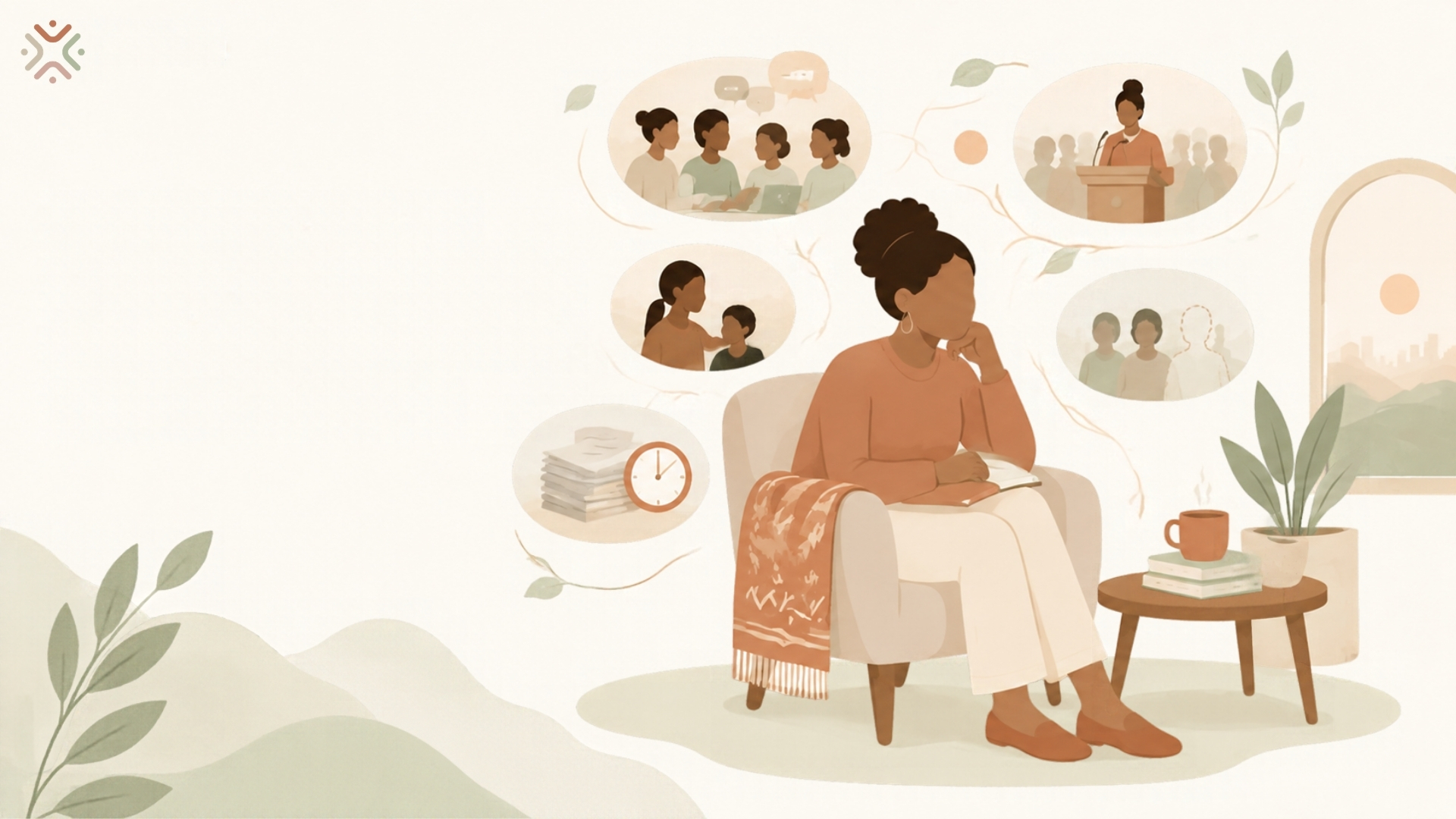
For some BIPOC professionals, success does not always feel safe. You may have the degree, the role, the promotion, the experience or the praise, and still feel as though you could be exposed at any moment.
You may worry that others overestimate your ability. You may overprepare, overwork or avoid asking questions because you do not want to seem incompetent. You may feel pressure to prove yourself repeatedly, especially if you are one of few people from your background in a workplace, industry or leadership space.
This is often described as imposter syndrome or the imposter phenomenon. Despite its name, it is not a formal mental health diagnosis (Bravata et al., 2020). BIPOC stands for Black, Indigenous and people of color; it is used mainly in North American contexts and does not mean everyone with an immigrant or minority ethnic background. People differ in whether they identify with this term. Experiences of racism, bias and underrepresentation may contribute to self-doubt for some professionals, but these experiences are not shared equally across groups or workplaces.
Online therapy can offer a private space to explore self-doubt, pressure, racial stress and perfectionism without reducing your experience to “low confidence.” It can help you rebuild self-trust while also recognising the environments that made success feel unsafe.
Why can success still feel unsafe?
Success is often expected to create confidence. But for many BIPOC professionals, each achievement can bring a new level of pressure.
You may think that once you get the job, promotion or recognition, you will finally feel secure. Instead, you may feel more visible, more watched or more afraid of making mistakes.
This does not mean you are unqualified. It may mean that success has placed you in spaces where you still do not feel fully safe, represented or understood.
Feeling like you have to keep proving yourself
Some professionals feel that one achievement is never enough.
You may work hard to reach a position, then feel immediate pressure to prove you deserve to stay there. You may feel that others are allowed to learn, make mistakes or ask for help, while you must arrive fully prepared at all times.
This can become especially heavy if you are the only person, or one of few people, from your racial, cultural or immigrant background in the room.
You may worry that your mistake will not be seen as an ordinary mistake. It may be seen as evidence that you do not belong. Or worse, as evidence confirming a stereotype about people like you.
Online therapy can help you name this pressure clearly. It can support you in separating your actual competence from the exhausting need to prove yourself again and again.
When praise does not feel believable
Imposter feelings often make praise hard to receive.
Someone may compliment your work, but your mind quickly explains it away:
“They are just being nice.”
“I got lucky.”
“They do not know how much I struggled.”
“Anyone could have done this.”
“If they looked closer, they would see I am not that good.”
For BIPOC professionals, praise can also feel complicated when you have experienced bias or tokenism. You may wonder whether you were praised because your work was strong, because someone wanted to appear inclusive, or because expectations for you were lower than for others.
This can make it difficult to trust positive feedback.
Therapy can help you explore why praise feels unsafe. Sometimes the issue is self-criticism. Sometimes it is past invalidation. Sometimes it is a workplace where feedback has not felt fair or consistent.
Being visible and invisible at the same time
Many BIPOC professionals describe a painful contradiction: being highly visible as “different,” while feeling invisible as a full person.
You may be noticed because of your race, accent, name, appearance, religion, migration background or cultural identity. But your skills, individuality, leadership style or emotional reality may be misunderstood.
You may feel visible when the workplace wants diversity, but invisible when you need support, credit or protection from bias.
This can make success feel unstable. You may feel included in appearance but not fully held in practice.
If this tension feels familiar, it may connect with the wider emotional cost of code-switching and adapting to dominant workplace norms.
How does imposter syndrome affect BIPOC professionals?
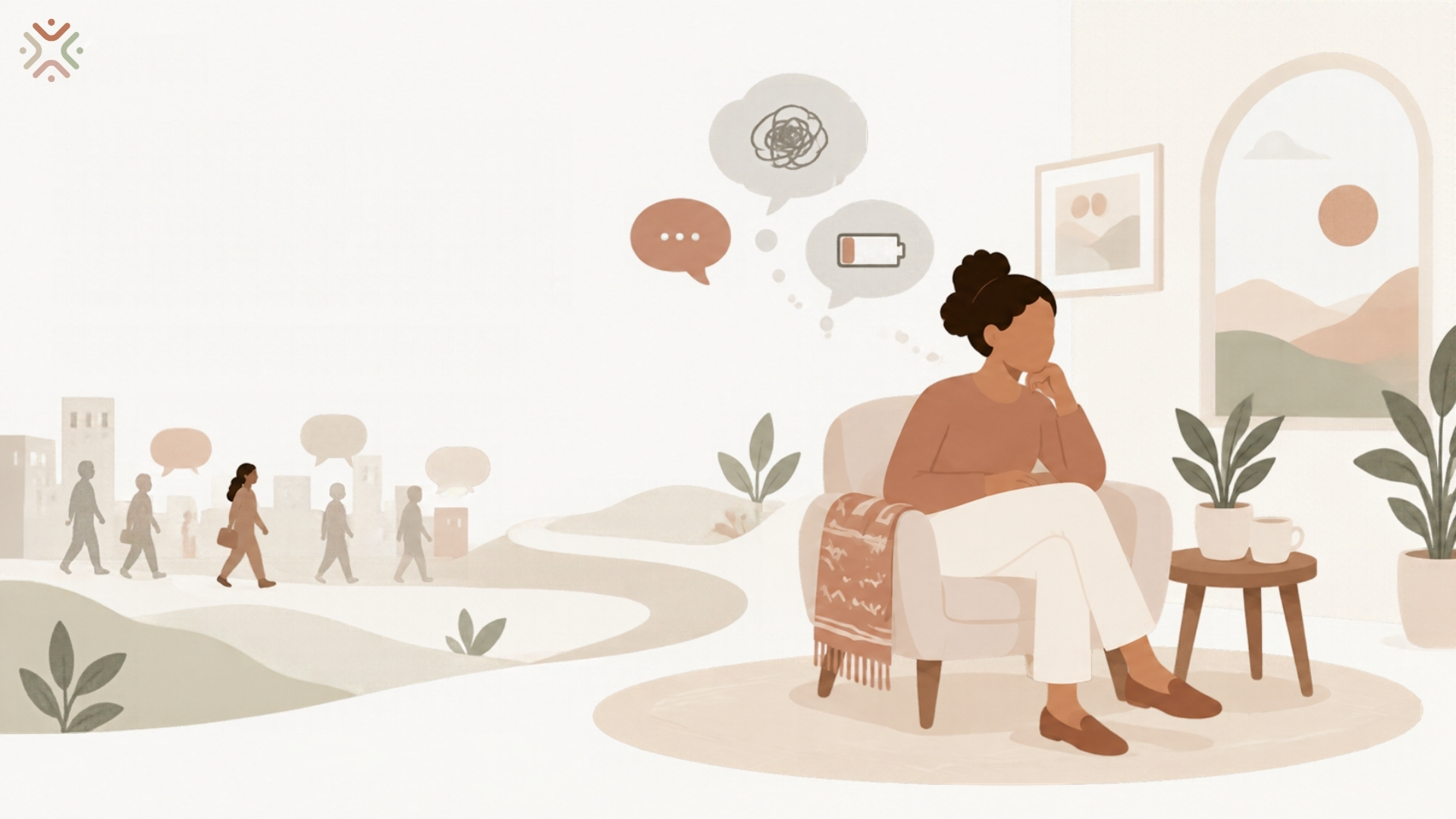
Imposter syndrome can affect thoughts, emotions, behaviour and the body. It can shape how you work, how you speak, how you respond to feedback and how much rest you allow yourself.
It may push you to work harder, but in a way that is driven by fear rather than purpose. Over time, this can become exhausting.
Overworking to avoid being exposed
One common pattern is overworking.
You may spend far more time preparing than the task requires. You may check everything repeatedly. You may avoid delegating because you fear being judged. You may say yes to extra work because you want to prove your value.
At first, this can look like dedication. Others may praise you for being reliable, excellent or hardworking.
But inside, you may feel trapped. The more you achieve through overwork, the more your mind believes that overwork is the only reason you are safe.
Online therapy can help you understand the fear underneath overworking. It can also help you build a more sustainable relationship with performance.
If perfectionism and achievement pressure are part of your experience, it may help to read more about pressure to succeed in immigrant and diaspora families.
Avoiding questions, feedback or visibility
Imposter feelings can also lead to avoidance.
You may avoid asking questions because you do not want to look unprepared. You may avoid presenting ideas because you fear criticism. You may avoid applying for promotions because part of you believes you are not ready, even when you are qualified.
You may also avoid feedback. Not because you do not care, but because feedback feels threatening. A small critique may feel like proof that you never belonged.
For BIPOC professionals, visibility can feel especially risky. Being seen can bring opportunity, but also scrutiny. You may want recognition and fear it at the same time.
Online therapy can help you approach visibility more gradually and with more self-trust.
Anxiety, burnout and never feeling enough
Imposter feelings may involve persistent worry about mistakes, criticism or being exposed as less capable than others believe.
You may feel anxious before meetings, presentations or reviews. You may replay conversations afterward. You may feel restless during time off because your mind is searching for what you missed.
Imposter feelings have been associated with burnout, although this does not establish that they cause it (Bravata et al., 2020).
This is not because you are weak. It may be because you have been trying to maintain success while carrying fear, bias, self-monitoring and pressure without enough support.
If exhaustion is already affecting your mood, identity or daily life, it may help to read more about returning to yourself after burnout.
Why imposter feelings are not only a personal problem
It can be tempting to treat imposter syndrome as something that happens entirely inside a person’s mind. But for many BIPOC professionals, the environment matters.
If you have been underestimated, stereotyped, excluded, tokenised or treated as though you do not belong, self-doubt may not come from nowhere. It may be a response to repeated cues that safety and acceptance are conditional.
Therapy can support the individual, but workplaces also have responsibility.
Bias can make competence feel fragile
When bias exists, competence may not feel like enough.
You may be highly skilled and still questioned more often. You may have strong ideas and still be interrupted. You may be qualified and still feel you need extra evidence to be taken seriously.
This can make confidence harder to sustain. You are not only evaluating your ability. You are also tracking how others may interpret you through bias.
Online therapy can help you examine self-doubt alongside specific workplace experiences, including possible bias. These can coexist: the aim is to consider the evidence and impact without automatically treating the problem as either personal inadequacy or discrimination.
If racial stress is part of your work life, it may help to explore that directly.
Underrepresentation can increase pressure
When there are few people from your background in a space, success can feel lonely.
You may feel pressure to represent your community well. You may avoid showing uncertainty because you do not want to reflect badly on others. You may feel grateful for the opportunity and angry that you had to fight so hard for it.
Underrepresentation can also make it harder to find mentors, role models or colleagues who understand your experience. Without those mirrors, it can be easier to believe that you are the problem.
Online therapy can offer a place to process that loneliness and rebuild a sense of belonging that is not dependent on constant performance.
Stereotype threat and the fear of confirming assumptions
Some BIPOC professionals carry a fear of confirming stereotypes. This may happen consciously or quietly in the background.
You may worry that if you speak too strongly, you will be seen as aggressive. If you make a mistake, you will be seen as less capable. If you ask for help, others will assume you are not ready. If you rest, you will be seen as less committed.
This can make everyday work emotionally loaded.
The pressure to avoid confirming assumptions can fuel perfectionism, overwork and silence. Therapy can help you understand these patterns with compassion, rather than blaming yourself for feeling tense.
How online therapy can support imposter syndrome
Online therapy can help BIPOC professionals work through imposter feelings in a way that includes both the internal experience and the external context.
A culturally sensitive therapist should not treat self-doubt as if it exists outside race, culture, workplace power, family history or social identity. These factors may shape why success feels unsafe.
Naming the story behind self-doubt
Self-doubt has a history.
It may come from family pressure, school experiences, racism, class mobility, workplace bias, immigration stress, perfectionism or being praised only when you overachieved.
Online therapy can help you understand the story behind the feeling.
Instead of asking only, “How do I become more confident?” therapy may help you ask:
When did success start feeling unsafe?
When did I learn I had to be perfect to be accepted?
Whose standards am I trying to meet?
What happens inside me when I receive praise?
What am I afraid people will discover?
What would change if I trusted my competence?
These questions can help you respond to self-doubt with more awareness.
Building self-trust without ignoring workplace reality
Therapy can help build self-trust, but not by pretending that bias does not exist.
For BIPOC professionals, self-trust may include recognising both truths: you are competent, and some environments may still treat you unfairly.
This distinction matters.
You do not need to blame yourself for every moment of doubt. You also do not need to let biased environments define your worth.
Online therapy can help you build confidence that is grounded in evidence, values, boundaries and self-compassion, not in constant approval from people who may not fully understand your experience.
Reducing perfectionism and overwork
Imposter feelings often lead to perfectionism.
You may try to become so prepared, polished or excellent that no one can question you. But perfectionism does not create safety for long. It usually raises the standard again.
Therapy can help you notice where perfectionism is protecting you and where it is harming you.
This may include practising realistic standards, tolerating uncertainty, accepting mistakes as part of learning and learning to rest without guilt.
If you are the high-achieving child of immigrants, this work may also involve family expectations, sacrifice and the fear of wasting opportunity.
For private support with anxiety, self-doubt, burnout or workplace pressure, online individual therapy can offer a place to begin.
What if the workplace needs to change too?
Therapy can help you care for your mental health, but it should not turn systemic problems into purely personal problems.
If your workplace repeatedly makes you feel unsafe, excluded or unsupported, the solution cannot only be “be more confident.” Culture, leadership, feedback systems, promotion practices and psychological safety also matter.
Confidence is not a replacement for equity
Confidence can help, but it cannot fix every workplace problem.
A person can be confident and still face bias. A person can be skilled and still be overlooked. A person can communicate clearly and still be misunderstood through stereotypes.
This is why employee wellbeing should include equity, belonging and culturally responsive support, not only resilience workshops or productivity tools.
For organisations supporting diverse teams, Thera’s employee wellbeing support may be relevant.
You may need support, boundaries or a different environment
Sometimes online therapy helps you stay and navigate a workplace with more clarity. Sometimes it helps you set boundaries. Sometimes it helps you decide that an environment is no longer sustainable.
The goal is not to make every workplace feel acceptable. The goal is to help you listen to yourself, protect your wellbeing and make choices with more steadiness.
Therapy can support practical questions like:
What is mine to work on?
What belongs to the workplace?
What boundaries are realistic?
What support do I need?
What would make this environment healthier?
What would tell me it is time to leave?
Privacy can make honesty easier
Many professionals do not feel safe talking about imposter feelings, racial stress or workplace anxiety with colleagues. They may fear being judged, misunderstood or seen as less capable.
Online therapy may offer flexibility and space to discuss concerns you do not want to share at work. Before starting, ask about confidentiality and its limits, how sessions and records are protected, and whether the therapist can provide care where you are located.
If privacy is one reason support feels hard to access, it may help to read more about confidential therapy for BIPOC communities.
What the research says
The imposter phenomenon describes difficulty recognising one’s accomplishments and fear of being exposed as a fraud despite evidence of competence. A systematic review found associations with anxiety, depression and burnout, but studies varied substantially in their populations and methods. Some studies involving racially and ethnically minoritized students also linked imposter feelings with discrimination or minority-related stress; these findings should not be assumed to describe every BIPOC professional or workplace (Bravata et al., 2020). The review found no eligible treatment studies within its search period, which ended in May 2018. It therefore does not establish that online therapy specifically treats imposter feelings. Therapy may nevertheless offer support with associated distress and help people consider personal and workplace factors.
Success should not require constant fear
You do not have to keep proving your worth forever.
You can be skilled and still need support. You can be successful and still feel unsafe. You can feel self-doubt without letting it define your ability. You can name workplace bias without dismissing your own growth.
Online therapy can help you build a more stable relationship with success — one that includes confidence, boundaries, rest and emotional safety.
You can explore more articles on identity, culture and mental health on the Thera blog.
If you want to ask questions before starting, you can book a free discovery call and explore whether online therapy feels right for you [internal link: free discovery call.
If self-doubt is affecting how you work or making it difficult to switch off, you can discuss that in therapy alongside any workplace pressures you are facing.


















 Previous article
