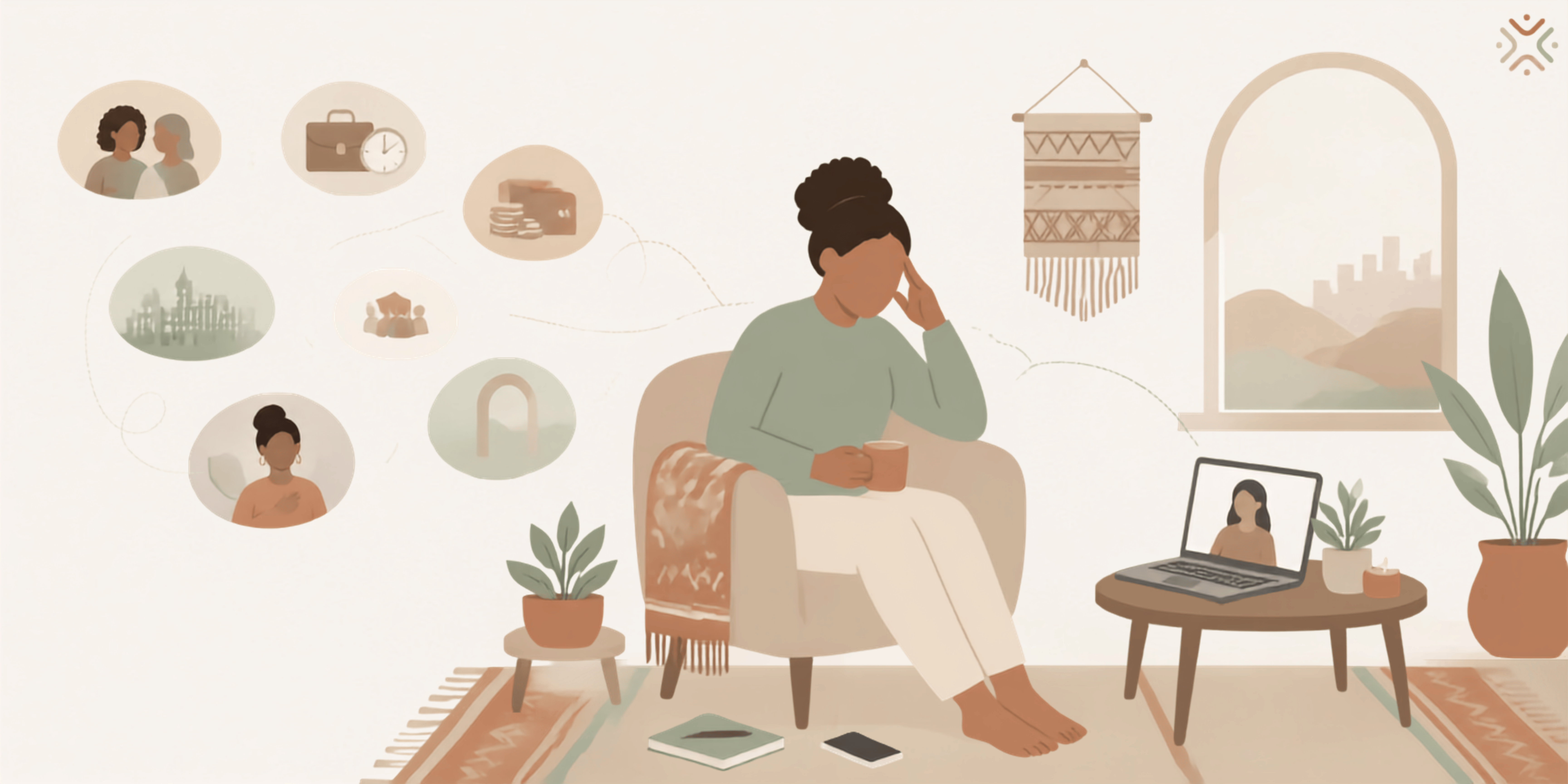
Anxiety does not always look like panic or visible distress. Sometimes it looks like replaying conversations again and again. Sometimes it looks like checking your phone for reassurance. Sometimes it looks like lying awake at night, thinking about family, work, money, faith, safety, relationships or the future.
For many BIPOC clients, people of color, immigrant families and culturally diverse communities, anxiety may be shaped by more than everyday stress. It can be connected to family expectations, racism, migration pressure, religious or cultural guilt, community judgment and the feeling that one mistake could disappoint many people.
You may call it “overthinking.” You may tell yourself you are just being responsible. But when worry becomes repetitive, exhausting and difficult to control, it may be a sign that you need support.
When worry becomes more than normal stress
Everyone worries sometimes. Worry can help us prepare, plan and take responsibility. Anxiety can go beyond useful planning. It may keep the mind looping even when there is no clear action left to take. “Overthinking” is an everyday term rather than a diagnosis, and it can describe many experiences, including stress, uncertainty, perfectionism, rumination or anxiety.
A mental-health professional can assess whether worry may be part of an anxiety disorder by looking at how persistent and difficult to control it feels, the physical and emotional symptoms involved, and how much it affects daily life. You do not need to identify the right label before seeking support.
The difference between planning and constant overthinking
Planning usually helps you move forward. You think about a situation, consider your options, decide what to do and take the next step.
Overthinking keeps you stuck. You replay the same conversation, imagine the worst-case scenario, search for hidden meanings or ask several people for reassurance, but still do not feel settled.
For example, someone may send a simple message to a parent, manager or partner, then spend hours wondering: “Did that sound rude?” “Will they be disappointed?” “Should I explain again?” “What if I made things worse?”
Anxiety can feel like trying to be careful. It can feel like being responsible. But if it leaves you drained, tense and unable to act, it may no longer be helping. If you are unsure whether this kind of worry is serious enough for support, it may be worth asking when emotional struggles become too heavy to carry alone.
Physical signs of anxiety
Anxiety is not only in the mind. It can affect the body too.
You may notice tension in your shoulders or jaw, headaches, stomach discomfort, a racing heart, shallow breathing, restlessness, sweating, fatigue or sleep problems. Some people feel chest tightness or dizziness when worry becomes intense.
These symptoms can feel frightening. Anxiety can cause physical sensations, but physical symptoms should not automatically be assumed to be anxiety. Seek urgent medical help or emergency care for sudden, severe or concerning symptoms, particularly chest pain, severe shortness of breath, fainting, new weakness, or symptoms that could indicate a medical emergency. For ongoing or recurring physical symptoms, speak with a healthcare professional. But when the body reacts repeatedly during stress, conflict or uncertainty, anxiety may be part of the picture.
A young professional may appear calm in meetings while feeling physically tense throughout the day. For some people from racialised, immigrant or culturally diverse backgrounds, workplace pressure may also include experiences such as microaggressions, code-switching, isolation or concern about being judged more harshly than colleagues. These experiences vary across people, workplaces and contexts.
Stress and anxiety can affect the body as well as thoughts and emotions, although the exact pattern differs from person to person.
Avoidance, reassurance-seeking and emotional exhaustion
Anxiety can lead to habits that bring short-term relief but keep the worry going.
You may avoid difficult conversations, delay decisions, cancel plans, over-prepare, check repeatedly, ask others what they think or try to predict every possible outcome. Reassurance can bring brief relief for some people, but repeated reassurance-seeking may keep the worry cycle going over time.
Over time, this cycle becomes exhausting. You may feel tired from thinking, even if nothing visible has happened.
Therapy can help you notice these cycles and understand what your anxiety is trying to protect you from.
Why anxiety may look different in family and community life
Anxiety does not happen in isolation. For people from minority, immigrant or multicultural backgrounds, the same symptom can have a different emotional meaning.
Worrying about disappointing family
In many families, individual decisions are not seen as purely individual. Career, education, marriage, parenting, caregiving, money and lifestyle choices may feel connected to the whole family.
A person may worry that one decision will disappoint parents, create gossip, disrespect sacrifices or make them seem selfish. This can make everyday choices feel heavy.
Imagine a daughter of immigrants who wants to change careers. For her, this is not only a professional decision. It may feel like she is risking her parents’ pride, financial stability and the story they built around her success.
Therapy can help separate healthy responsibility from overwhelming pressure. It can also support conversations around family expectations.
Fear of making the wrong decision culturally, socially or spiritually
Some people do not only ask, “What do I want?” They also ask: “Is this acceptable in my family?” “Will my community judge me?” “Does this go against my values?” “Am I being selfish?” “Am I doing something wrong?”
These questions can matter deeply. Culture, faith and family values can provide guidance and meaning. But when fear takes over, the mind may become stuck in rumination.
A therapist does not replace a spiritual leader, cultural elder or personal values. Therapy does not decide what is right for you. Instead, it can help you understand the fear, guilt and emotional pressure around your decisions.
This is where cultural values and guilt may be especially relevant.
When people dismiss anxiety as weakness
In some families or communities, anxiety is misunderstood. A person may be told to stop thinking so much, be stronger, pray more, be grateful or remember that others have suffered worse.
These comments may be meant to help, but they can increase shame. The person may begin to believe that anxiety means they are weak, dramatic or lacking resilience.
But anxiety is not a character flaw. A person can be strong, faithful, responsible and grateful, and still struggle with anxiety.
Support should reduce shame, not add to it.
How therapy can help with anxiety and overthinking
Therapy does not promise to remove every worry from life. Instead, it helps you understand anxiety patterns, calm the nervous system and respond with more choice.
Understanding your anxiety triggers
Many people know they feel anxious, but not exactly what activates it. Therapy can help identify triggers such as family conversations, uncertainty, conflict, work pressure, spiritual guilt, discrimination, financial stress or relationship tension.
Once you understand the pattern, anxiety can feel less mysterious. You may begin to notice: “This happens when I fear disappointing someone,” or “My body reacts this way when I feel judged.”
That awareness is often the first step toward change.
Learning tools to calm the body and mind
Therapy may include practical tools such as grounding, breathing, journaling, thought-challenging, routine changes, body awareness or small behavioural experiments.
For example, if anxiety pushes you to seek reassurance repeatedly, therapy may help you practise waiting before asking. If worry keeps you awake, you may learn ways to externalise thoughts before bed. If conflict makes your body freeze, you may practise calming techniques before difficult conversations.
These tools work best when practised consistently, not only during moments of panic.
If you experience sudden surges of intense fear or discomfort, including symptoms such as a racing heart, shaking, breathlessness, dizziness or fear of losing control, this may be worth discussing with a healthcare or mental-health professional. You may also find this guide on panic attacks useful.
Making decisions with more clarity and less fear
Anxiety can make every choice feel dangerous or irreversible. Therapy can help you slow down, clarify your values and tolerate some uncertainty.
This is especially important when decisions involve family, identity, culture, religion, work or major life changes. The goal is not to make choices without fear. The goal is to stop fear from making every choice for you.
Over time, therapy can help you ask: What is my anxiety saying? What are my values saying? What information do I actually have? What small step can I take next?
Integrating culturally sensitive coping strategies
Coping tools work best when they respect the person’s real life. For some clients, that may include faith, family, community, movement, music, rest, nature, language, creativity or cultural practices.
Using spiritual or cultural practices without turning them into pressure
Prayer, meditation, scripture, rituals, ancestral practices, music, cooking, community connection or reflection can all support calm and meaning.
But even helpful practices can become another source of pressure if anxiety turns them into perfectionism. A person may worry they are not praying correctly, not grateful enough, not connected enough to culture or not living up to family expectations.
Coping should not become another way to judge yourself.
Therapy can help you relate to these practices with more compassion, rather than fear.
Therapy can support your values rather than compete with them
Some people worry that therapy will push them away from their culture, family or faith. Therapy should be collaborative and should make room to discuss the values, relationships, faith and cultural practices that matter to you.
A culturally-sensitive therapist can help you explore anxiety in a way that respects your identity and values. A therapist who is a good fit will aim to understand your cultural context without reducing it to a problem or ignoring pressures that may affect your wellbeing.
Therapy can support emotional wellbeing while making space for the beliefs, relationships and traditions that matter to you.
Worry does not have to run your life
If anxiety feels like constant overthinking, you are not alone. Many people live with worry for years before realising how much energy it takes.
You do not need to wait until anxiety becomes a crisis. You do not need to prove that your stress is worse than someone else’s. And you do not need to hide behind “I’m just overthinking” if the worry is affecting your sleep, relationships, work or sense of self.
Support may help you understand your worry patterns, consider what keeps them going, and practise responding with more steadiness and choice.










 Previous article
