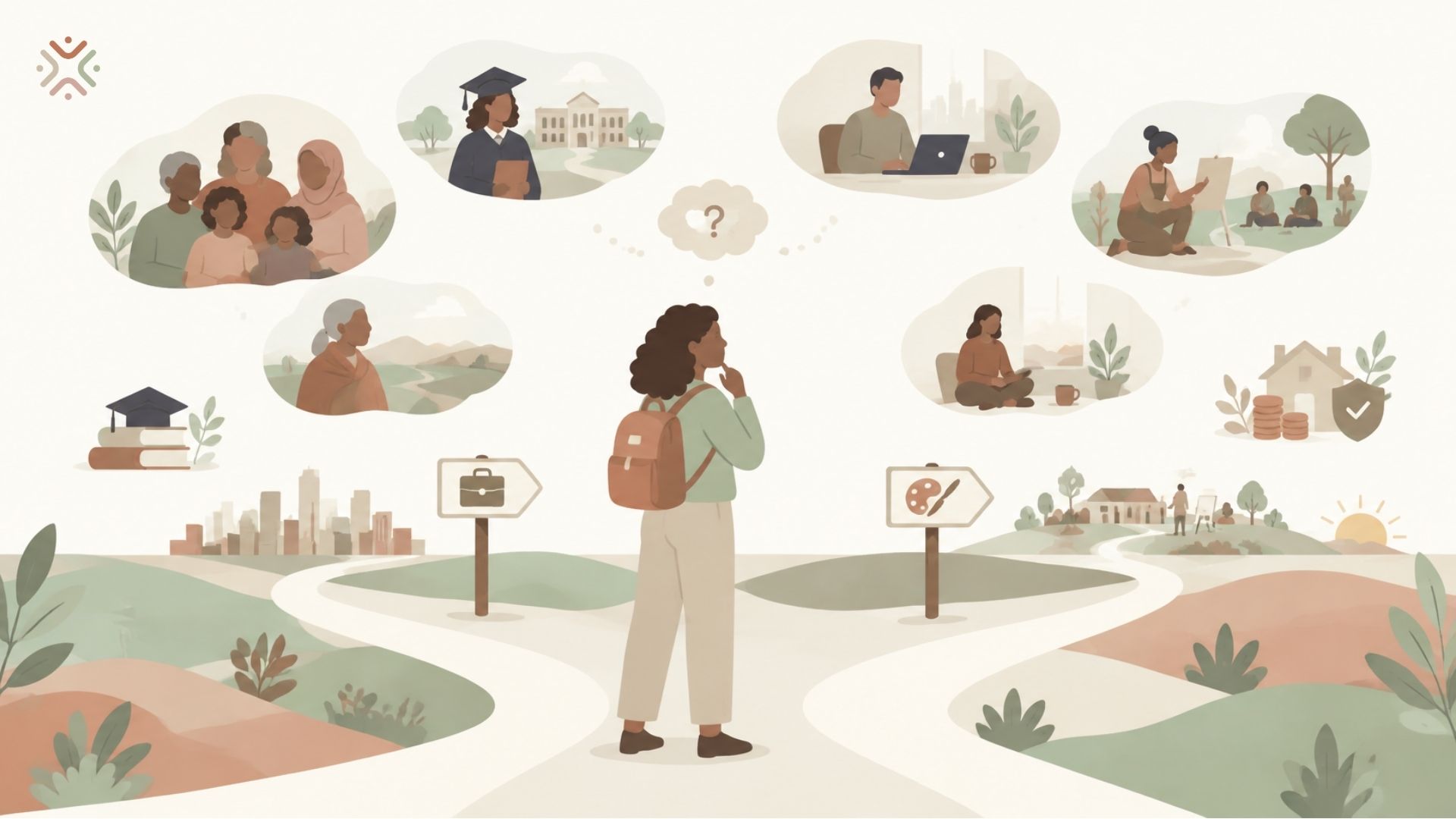
Choosing a partner can involve more than attraction, particularly when family relationships, cultural background, faith, language or future plans matter to the people involved.
For some adults of Moroccan, Algerian, Tunisian or other North African heritage living in France or Belgium, relationship decisions may involve family expectations, cultural continuity, religion or secular identity, language, community visibility, migration histories or questions about what kind of future feels right and safe. These considerations vary widely across individuals, families, regions and generations.
North African families do not share one set of values, religious beliefs or expectations about relationships. Some are Muslim, Christian, Jewish, secular or mixed. Some adults feel closely connected to their family's country of origin, while others identify primarily as French, Belgian, European, Amazigh, Arab or through several identities.
For some people, choosing a partner is largely a personal decision supported by family and friends. Others may experience uncertainty or disagreement when their preferences differ from those of people close to them.
Questions may include:
- Will my family accept this person?
- Does sharing a cultural background matter to me?
- What role should religion or language play?
- How involved do I want my family to be?
- Does my partner understand the values that matter to me?
Culturally sensitive online therapy can provide space to explore these questions without treating family relationships, cultural identity or religious beliefs as problems.
Why partner choice can feel emotionally complex
Partner choice is personal, but relationships also develop within social and family contexts.
Family connections, individual values, previous experiences and future plans may all influence what someone considers important in a partner.
For some people, these influences create reassurance and belonging. For others, differences in expectations may introduce uncertainty or conflict.
Family expectations may come from care and concern
Family expectations are not necessarily restrictive. Parents and relatives may offer advice because they care about someone's future, compatibility and wellbeing.
Some parents, relatives or respected family figures may worry about discrimination, divorce, isolation, cultural loss, religious difference or whether their adult child will be understood by a partner from another background.
They may hope their child finds someone who shares familiar traditions, language, religious values or expectations around marriage and children.
These concerns can coexist with respect for individual choice.
However, disagreements may become emotionally difficult when expectations are repeated, boundaries are unclear or someone feels unable to express a different opinion.
You may understand your family's concerns while wanting to make your own decision. You may appreciate their advice without agreeing with every recommendation.
It is possible to acknowledge both perspectives without assuming that family involvement is automatically supportive or controlling.
Shared background may matter, but not in the same way for everyone
Some North African-background adults prefer a partner who shares their cultural or religious background.
Shared language, faith, family traditions or experiences may make certain conversations easier. A common background can also provide a sense of familiarity and continuity.
Others may prioritise emotional compatibility, communication, shared goals or individual values over cultural similarity.
Neither preference is inherently more authentic or appropriate.
Someone from a different background may be respectful and curious about your experiences. Equally, a partner who shares your heritage may have different beliefs about family, religion or relationships.
Rather than assuming that cultural similarity guarantees compatibility, it may be more useful to consider what understanding means in everyday life.
Identity does not have to be reduced to one choice
Partner choice can raise questions about identity and belonging.
You may feel French or Belgian in daily life while remaining connected to your family's Moroccan, Algerian or Tunisian heritage. You may speak different languages at home and work or understand religion differently from your parents.
These aspects of identity do not necessarily conflict.
A relationship may bring them into focus, particularly when partners have different expectations about family involvement, religious practice or future children.
The challenge is not always choosing between two cultures. It may be understanding which values you want to maintain, adapt or share with a partner.
For people who feel caught between different cultural contexts, identity and belonging may be an important part of the wider conversation.
Common questions when culture, family and identity all matter
Relationship decisions can raise questions that do not have simple answers.
Some concern practical compatibility. Others involve emotional needs, family relationships or personal beliefs.
“Do I need someone who understands my culture?”
Wanting a partner who understands your background is reasonable.
You may value shared language, religious holidays, family traditions, humour or familiarity with your experiences growing up.
However, understanding does not always require identical backgrounds.
A partner from another culture may be willing to learn about your family and values. Someone from the same background may still have different expectations about privacy, commitment or daily life.
It may help to consider what understanding means to you:
- Do we need to share a language or religion?
- Can we discuss differences respectfully?
- How will we approach extended family relationships?
- Do we have compatible expectations about children?
- Can we disagree without feeling dismissed?
- Are we comfortable learning about each other's experiences?
These questions shift the focus from cultural labels to the relationship itself.
“What if my family disapproves?”
Family disapproval can be difficult, particularly when maintaining close relationships with relatives is important to you.
You may worry about disappointing your parents, creating conflict or making your partner feel unwelcome.
However, disapproval can take different forms.
A relative may express concern and remain willing to discuss the relationship respectfully. Another may repeatedly question your decisions or disregard requests for privacy.
In more serious circumstances, a person may experience intimidation, threats or coercion.
These situations require different responses.
Before deciding how to involve family members, consider:
- What concerns have relatives actually expressed?
- Can I disagree without fear of retaliation?
- Have similar disagreements occurred before?
- Am I financially or practically dependent on anyone involved?
- What support would I need before discussing the relationship?
You do not need to rush into a conversation simply because other people expect an explanation.
Where the circumstances are safe, family boundaries and respect can be part of finding a workable approach.
“What if I disappoint my parents?”
Some adults whose parents migrated to France or Belgium feel strongly connected to their family's experiences and sacrifices.
They may appreciate the opportunities their parents created while also wanting to make independent relationship decisions.
This can make disagreement emotionally complicated.
You may worry that choosing a partner your family did not expect will be interpreted as rejecting their values or disregarding their experience.
However, families respond differently. Some parents may need time to adjust, while others may be supportive from the beginning.
Online therapy may help you explore how love, gratitude, loyalty, autonomy and respect are experienced in your own life. It can create space to consider which expectations feel meaningful, which feel difficult, and what choices align with your values and safety.
When these questions create persistent distress, cultural values and inner conflict may also be worth exploring.
When relationship decisions affect mental wellbeing
Choosing a partner can be stressful when important preferences or relationships appear difficult to reconcile.
This is not specific to North African-background adults. Relationship uncertainty can affect people from many backgrounds.
The emotional impact depends on the individual's circumstances, previous experiences, available support and the nature of any disagreement.
Anxiety and overthinking
Some people find themselves repeatedly reconsidering their decisions.
They may worry about compatibility, family reactions or whether their relationship will remain stable.
Questions might include:
- What if I make the wrong decision?
- Am I overlooking an important concern?
- What if my family disagrees?
- What if my partner and I want different futures?
- Am I making this choice because it reflects my values or because I feel pressured?
Careful reflection is useful, but repeated worry may become exhausting when it interferes with sleep, concentration or everyday activities.
Individual support may help someone explore uncertainty and distinguish practical concerns from repetitive anxious thinking.
When anxiety feels like overthinking, it may also be useful to consider how worry is affecting decision-making.
Privacy, secrecy and isolation
Not everyone chooses to share details of their romantic relationships with family members.
Some people value privacy. Others may prefer to wait until a relationship becomes serious before involving relatives.
These choices are not inherently problematic.
However, keeping a relationship private can become distressing when partners have different expectations or someone feels isolated.
For example, one partner may want greater openness while the other prefers to wait before making introductions.
Discussing the reasons behind these preferences can prevent misunderstandings.
Confidential individual support may be helpful for someone who wants space to consider their feelings without involving relatives or a partner immediately.
The role of confidentiality in online therapy may be especially relevant when privacy is a concern.
Feeling responsible for your partner and your family
Sometimes a person feels responsible for maintaining positive relationships between their partner and relatives.
They may explain family expectations, clarify misunderstandings or try to prevent disagreements.
This role can be manageable when communication is respectful and responsibilities are shared.
It may become stressful when one person feels responsible for everyone else's reactions.
A partner may feel excluded from important decisions, while the other feels torn between different expectations.
Online couples therapy may help partners discuss these tensions when both people can participate freely and there is no fear, coercive control, violence, intimidation, surveillance or risk of retaliation for speaking honestly. Individual support may be safer when someone feels pressured, unsafe, unsure about the relationship or unable to speak openly in joint sessions.
Couples therapy should not be used to pressure someone into maintaining a relationship, accepting family demands or disclosing information that could place them at risk.
How online therapy can support partner choice
Online therapy does not determine which partner someone should choose or whether they should follow particular family expectations.
Instead, it can offer a space to consider personal values, relationship needs and the practical circumstances surrounding a decision.
A culturally responsive therapist should recognise the significance of family relationships, religion, migration history and identity without assuming that any one of these factors is inherently harmful.
Understanding what matters to you
When people around you have different opinions, it can be difficult to identify which considerations matter most.
Individual therapy may provide an opportunity to explore questions such as:
- What qualities do I value in a partner?
- Which family traditions are meaningful to me?
- What expectations do I share with my relatives?
- Which areas of disagreement are manageable?
- What role should religion or language play in my future?
- What kind of family involvement would I welcome?
- What practical circumstances affect my choices?
There may not be one perfect answer.
The purpose is to understand your circumstances and preferences more fully, not to reach a predetermined conclusion.
Preparing for family conversations
Some people decide to discuss their relationship with family members. Others prefer to keep the decision private, delay the conversation or seek support first.
These examples are not rules. Whether, when and how to discuss a relationship with family should depend on your circumstances, practical dependence, housing, finances, immigration status, family dynamics and safety. You do not have to disclose a relationship or confront relatives before you feel ready or have appropriate support.
Where it is safe to have an open conversation, you might use language such as:
“I understand why this matters to you, and I want to discuss it respectfully.”
“I know this may not be what you expected, but I would like you to understand why this relationship matters to me.”
“I want to hear your concerns respectfully. If the conversation becomes hurtful or I do not feel safe continuing, I will need to pause and return to it later.”
“I value our relationship, and I also need time to consider this decision.”
These are examples rather than recommended responses for every situation.
A conversation may need to be postponed or avoided when there is a risk of retaliation.
If disclosure could threaten your housing, financial stability, immigration circumstances or physical safety, seek appropriate support before taking further steps.
Building a relationship that can hold differences
Partners from different backgrounds may benefit from discussing expectations before major decisions arise.
Topics could include religious practice, family involvement, finances, language, holidays, parenting, caregiving and where to live.
The important question is not whether the partners have identical expectations. It is whether they can discuss differences respectfully and make decisions freely.
A culturally responsive therapist can facilitate these conversations when both partners feel safe participating.
For couples navigating significant cultural differences, intercultural relationships and family approval may provide additional context.
Thera also offers online couples and family therapy for situations where joint sessions are appropriate.
When safety and consent need priority
Family disagreement is not the same as coercion or abuse.
Parents and relatives may express preferences, offer advice or feel disappointed without attempting to control someone's decisions.
However, some situations involve intimidation, threats, surveillance or pressure that interferes with a person's ability to choose freely.
These risks can occur across different family, religious and cultural backgrounds. They should not be presented as typical of North African families or communities.
Recognising signs of coercion
Warning signs may include:
- threats of violence or serious consequences for refusing a relationship or marriage;
- pressure to marry someone against your will;
- monitoring of messages, phone calls, location or online activity;
- restrictions on leaving home or contacting other people;
- threats involving housing, money or immigration status;
- intimidation or fear of retaliation for discussing your relationship.
These situations require a different response from ordinary family disagreement.
In particular, an arranged marriage entered into with free consent is not the same as a forced marriage. Coercion removes or undermines that freedom of choice.
If you are concerned that someone is monitoring your communications, avoid using shared devices or accounts for sensitive conversations when doing so could increase risk.
You do not have to disclose or confront
If you are experiencing coercion, threats or fear of harm, you do not need to disclose your relationship, confront relatives or attend a joint therapy session before seeking support.
Safety planning and specialist advice may be more appropriate than attempting to resolve the situation through family discussions.
Where forced marriage or violence is suspected, involving family members in mediation can increase risk.
A therapist should not pressure someone to reconcile with relatives, continue a relationship or participate in joint sessions when they cannot speak freely.
Finding appropriate support
For people living in France or Belgium, local safeguarding, domestic abuse and legal support services can provide guidance appropriate to their circumstances.
In France, 3919 - Violences Femmes Info offers confidential information and support for women experiencing violence, including forced marriage. It is not an emergency number.
In Belgium, 1712 provides information and referrals concerning violence and abuse through its service in Flanders and Brussels.
The UK Forced Marriage Unit also provides safeguarding guidance, although its services should not be treated as a replacement for local support in France or Belgium.
Information about coercive control is available through Women's Aid.
If you are in immediate danger in France or Belgium, contact local emergency services. The European emergency number is 112.
What if there is no perfect choice?
Some decisions involve competing priorities.
You may value your family's advice while also wanting independence. You may prefer a partner who shares your cultural background but feel compatible with someone from another background.
You may need to consider practical questions about housing, finances, future children or maintaining relationships with relatives.
Not every disagreement can be resolved immediately, and not every decision will satisfy everyone involved.
You can value family and make your own decisions
Maintaining family relationships does not require everyone to agree about every aspect of your personal life.
You may value your family's history, language, faith and traditions while holding different preferences about relationships.
Some families welcome these differences. Others may need time to adjust.
The appropriate approach depends on the people involved and the circumstances rather than on a general rule about independence or family loyalty.
You can take time to decide
Some relationship decisions benefit from reflection.
You may want to understand your own values, discuss differences with a partner or consider practical circumstances before involving other people.
Taking time does not necessarily mean avoiding a decision.
It can allow you to consider the available options without feeling required to resolve every concern immediately.
For people seeking private support with relationship decisions, family expectations or anxiety, online individual therapy may be one option.
What research suggests
Demographic research in France and Belgium suggests that partner choice and family formation among descendants of immigrant groups are shaped by multiple factors, including individual preferences, social opportunities, migration histories and partner background. These patterns vary across groups and do not predict what any individual person, family or relationship will value or experience.
Relationship research also suggests that perceived approval or disapproval from family and social networks may be associated with relationship quality and conflict for some couples. This does not mean family involvement is always harmful or that a relationship needs family approval to be healthy. It means that outside reactions can become one factor a couple may need to navigate.
Culturally responsive therapy can offer a space to explore how family relationships, identity, faith, culture and personal values affect a particular decision, without treating any one background as the problem.
You deserve space to consider your choices
Choosing a partner can involve personal preferences, family relationships, cultural identity and plans for the future.
For some people, these considerations fit together comfortably. Others may experience disagreement or uncertainty.
Neither experience should be assumed on the basis of someone's cultural background.
Family involvement can provide meaningful support, while individual choice and freedom from coercion remain important.
If relationship decisions are causing distress, confidential support may offer space to consider your circumstances without pressure to reach a particular conclusion.
You can explore more articles on identity, relationships and emotional wellbeing on the Thera blog.
You can also browse Thera's therapist directory to explore professionals whose approaches may fit your needs and circumstances.
If you have questions about accessing online therapy, you can arrange a free discovery call when it is safe and private for you to make contact.
Your relationship decisions deserve consideration of your values, circumstances and wellbeing, without assumptions about what your family or cultural background should mean for you.










 Previous article
